Adaptive Bitrate Streaming Explained — How ABR Works in HLS
If you're wondering about adaptive bitrate streaming, this complete adaptive bitrate streaming guide explains everything. Adaptive bitrate streaming (ABR) is why Netflix doesn't buffer when Wi-Fi drops. This adaptive bitrate streaming tutorial covers how adaptive bitrate streaming works, how the player decides when to switch quality in adaptive bitrate streaming, and what adaptive bitrate streaming means for IPTV playlists. Understanding adaptive bitrate streaming is essential for smooth video delivery.
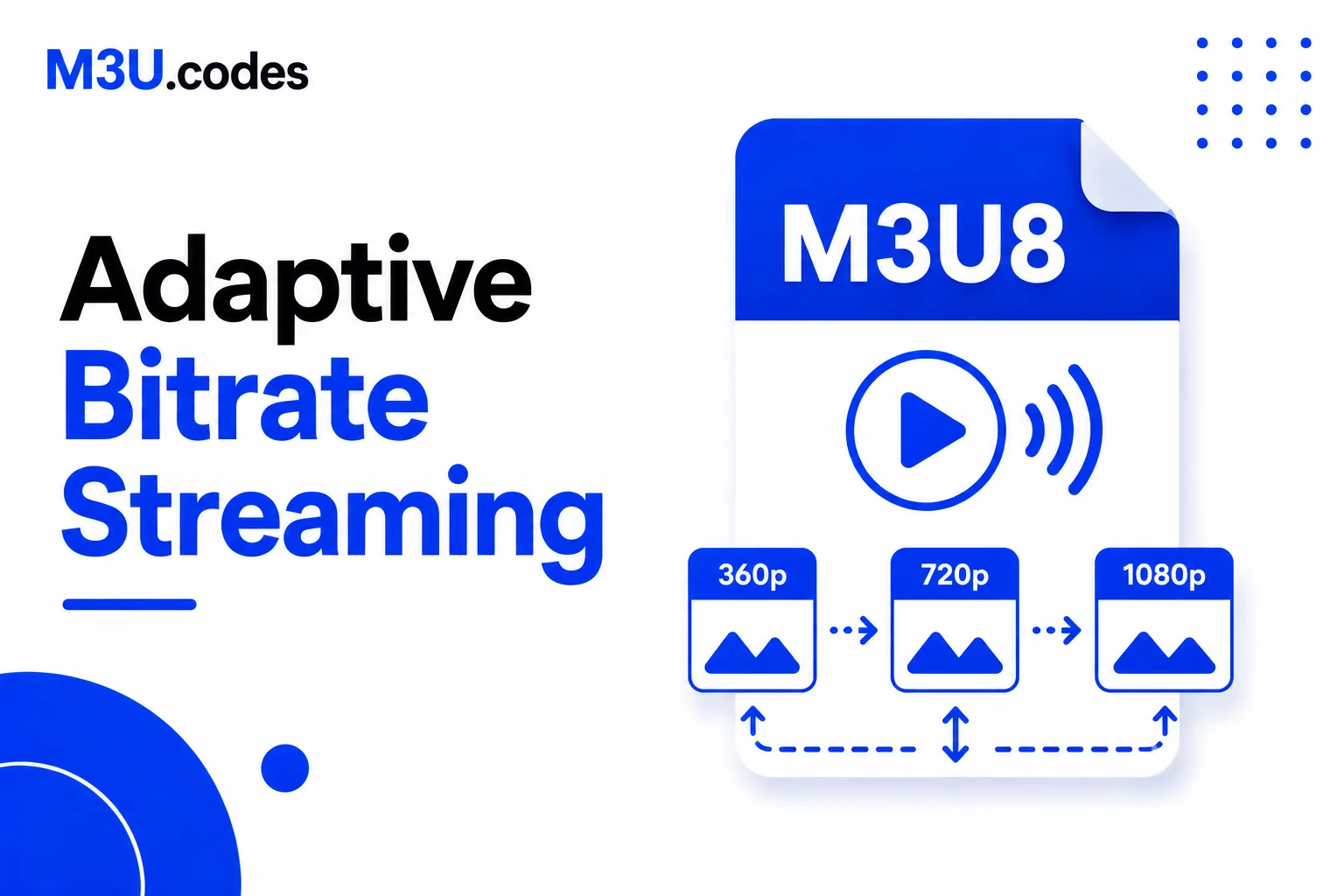
What Is Adaptive Bitrate Streaming?
Adaptive bitrate streaming (ABR) is a delivery technique where the same content is encoded at multiple quality levels (bitrates), and the adaptive bitrate streaming player switches between them in real time based on available bandwidth.
Rather than committing to one fixed quality at the start, an adaptive bitrate streaming player continuously monitors your connection speed and adjusts what it downloads next. If your internet slows down, adaptive bitrate streaming switches to a lower quality and keeps playing. When speed recovers, adaptive bitrate streaming switches back up. The viewer sees a brief quality change but never a spinning buffering indicator.
How Adaptive Bitrate Streaming Works in HLS
In HLS, adaptive bitrate streaming is implemented through the master playlist. The master M3U8 file for adaptive bitrate streaming lists all available renditions with their bandwidth requirements and resolutions:
#EXTM3U
#EXT-X-STREAM-INF:BANDWIDTH=400000,RESOLUTION=640x360,CODECS="avc1.64001e,mp4a.40.2"
360p/index.m3u8

#EXT-X-STREAM-INF:BANDWIDTH=1400000,RESOLUTION=1280x720,CODECS="avc1.64001f,mp4a.40.2"
720p/index.m3u8

#EXT-X-STREAM-INF:BANDWIDTH=4000000,RESOLUTION=1920x1080,CODECS="avc1.640028,mp4a.40.2"
1080p/index.m3u8
Each adaptive bitrate streaming rendition points to its own media playlist listing the segments for that quality level. The adaptive bitrate streaming player:
- Loads the adaptive bitrate streaming master playlist
- Starts downloading at the lowest rendition (to get adaptive bitrate streaming playback started quickly)
- Measures the download speed of each segment
- Uses that measurement to estimate available bandwidth for adaptive bitrate streaming
- Selects the highest rendition whose bandwidth requirement fits within available capacity
- Switches renditions at segment boundaries (every 6 seconds for typical adaptive bitrate streaming in HLS)
The Adaptive Bitrate Streaming Decision Algorithm
Modern adaptive bitrate streaming algorithms consider multiple signals, not just raw download speed:
- Buffer health: How many seconds of content are pre-downloaded. A well-filled buffer can sustain a higher bitrate even if instantaneous speed drops.
- Throughput estimate: Average download speed over recent segments, weighted toward recent measurements.
- Segment download time: How long the last segment took to download vs its duration — if it took longer to download than it is to play, the buffer is draining.
- Predictive models: Advanced players use machine learning to predict bandwidth changes before they happen.
Building a Good Bitrate Ladder for Adaptive Bitrate Streaming
For IPTV and VOD providers, the bitrate ladder — the set of renditions in the adaptive bitrate streaming master playlist — determines how well adaptive bitrate streaming works for viewers on different connections.
| Resolution | Target bitrate | Use case |
|---|---|---|
| 360p | 400 Kbps | Mobile data, slow connections |
| 480p | 800 Kbps | Standard mobile |
| 720p | 1.5–2.5 Mbps | Most home broadband |
| 1080p | 3–5 Mbps | Fast broadband, TV screens |
| 4K (2160p) | 15–25 Mbps | Gigabit connections, 4K displays |
A missing rung in the ladder creates a large quality gap. If a viewer on a 1.5 Mbps connection can only choose between 400 Kbps (360p) and 2.5 Mbps (720p), and 720p is too demanding, they'll be stuck at 360p even though the connection could support 720p at lower bitrate.
Adaptive Bitrate Streaming and IPTV
Most IPTV stream URLs in M3U playlists point directly to a single-bitrate stream — there's no adaptive bitrate streaming master playlist with multiple renditions. The player cannot switch quality because there's only one option. This is why IPTV streams buffer more than Netflix on the same connection: Netflix uses full adaptive bitrate streaming; most IPTV streams don't.
Higher-quality IPTV providers do offer adaptive bitrate streaming via an HLS master playlist URL. In this case the stream URL in the M3U points to an adaptive bitrate streaming .m3u8 master playlist, and the IPTV player handles adaptive bitrate streaming automatically.
Low-Latency Adaptive Bitrate Streaming (LLHLS)
Standard adaptive bitrate streaming in HLS has 6–30 seconds of live delay because the player needs to buffer several segments before switching. Low-Latency adaptive bitrate streaming (LLHLS) reduces this to under 2 seconds by publishing partial segments, allowing adaptive bitrate streaming quality decisions to be made faster. Low-Latency adaptive bitrate streaming is increasingly used for live sports where low latency matters.
Frequently Asked Questions About Adaptive Bitrate Streaming
What is adaptive bitrate streaming?
Adaptive bitrate streaming (ABR) automatically adjusts video quality in real-time based on the viewer's bandwidth and device capabilities. The player monitors download speed during adaptive bitrate streaming and switches between quality levels seamlessly to maintain continuous playback without buffering.
How does ABR prevent buffering?
Adaptive bitrate streaming prevents buffering by detecting bandwidth drops and switching to lower-quality renditions before the buffer empties. This maintains continuous playback even when network conditions change during adaptive bitrate streaming sessions. The adaptive bitrate streaming algorithm constantly monitors connection quality.
What is a bitrate ladder?
In adaptive bitrate streaming, a bitrate ladder is the set of quality levels available in an ABR stream. Example adaptive bitrate streaming ladder: 360p at 400 Kbps, 720p at 2 Mbps, 1080p at 4 Mbps. More rungs in the adaptive bitrate streaming ladder provide smoother quality transitions but increase storage and encoding costs.
Do all streaming protocols support ABR?
HLS and MPEG-DASH both support adaptive bitrate streaming natively. RTMP and basic progressive download (MP4) do not support adaptive bitrate — they stream at a single fixed quality without the ability to adjust during adaptive bitrate streaming playback.